
Time - Do we really all have 24 hours a day?
Whilst CEOs around the world sit and tweet for 16 hours a day, some workers are compelled to work that same length or more

Article written by Samuel Ng in collaboration with Workers Make Possible, in conjunction with their Labour Day Rally at Hong Lim Park (3 - 7 pm)
“I work from 7am to 10pm. Except public holidays—not enough people and a lot more chickens come in... then I sometimes work until midnight.” This work schedule would be unimaginable for many Singaporeans. Not for Khalid*, 26, who considers his current job in food processing “very good” compared to the working conditions in his previous job.
In this article, we explore how migrant workers are linked to the general Singaporean labour struggle, identify where and why labour still remains gendered, and situate this in the global capitalist system—all to illustrate what we can do in Singapore for the working class to take back agency and power as the current system rots.
Khalid first came to Singapore in 2022 as a construction worker, joining the ranks of the 400,000+ workers in the construction, maritime and processing (CMP) sector [1]. Like many of his compatriots from Bangladesh, he had paid a recruitment fee to come here in search of a good job. Yet, even after working 11 hours a day, his paycheck at the end of the month was around S$850. Deducting the basic necessities (S$300 in food and transport, and a $400 family remittance) Khalid is left with a paltry S$150 in savings for emergencies and his future. Many times, after a long week of work, he’d want to buy fast food as a treat. However, he could only afford to stare through the store windows and sigh. Smelling the fried chicken, he would think of how much a KFC meal would cost. Then, he would think of his family, and how much this money would mean to them. So he would walk on.
Khalid is not alone. Basic salaries for work permit holders like him in the construction sector have stagnated for the past 10 years: S$18 a day [2]. Such a low wage means that these workers have to work more and more overtime to even afford living in Singapore. Of course, inflation is not unfamiliar to Singaporeans. Many of us have deeply felt its impact in squeezing away both our time and money. A recent survey of Singaporean workers found that 4 in 10 took on part-time or freelance jobs to cope with inflation. This is in addition to more than half of those surveyed cutting back on discretionary spending [3]. Even then, Singaporeans generally have a social safety net (albeit thin and hole-ridden). For migrant workers, who receive neither the Progressive Wage Model (PWM) nor the GST vouchers, we ask: how to survive?
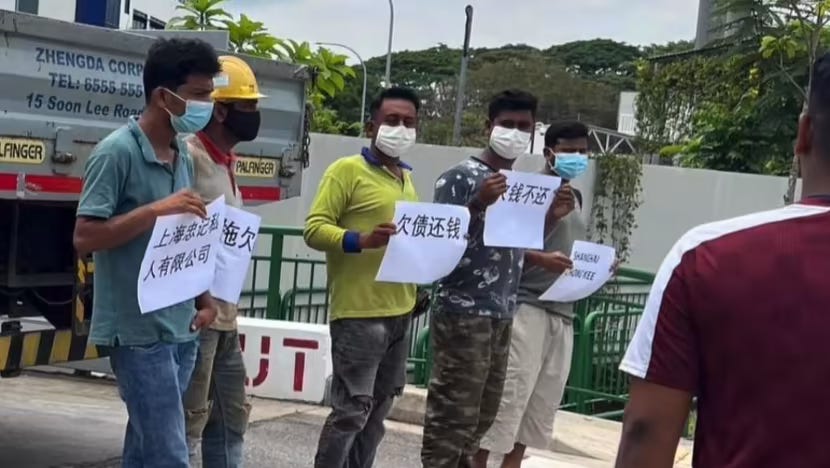
Migrant workers demanding the payment of their salaries on Oct 18, 2022. (Screengrab: Instagram/singapore_incidents)
The government’s answer has been stubbornly consistent: wage growth through upskilling [4]. In 2014, the government mandated that 10% of all workers in construction firms become higher-skilled workers [5]. The reality of capitalism, however, is that upskilling does not eradicate systemic wage suppression. Their wages were low, and remain low. A study done on migrant workers found that many of those who were upskilled and obtained certifications found no increase in salary [6]. This was because other people at their company - having seen the necessity and benefits of upskilling - also upskilled. Consequently, each individual worker had a net-zero competitive advantage, despite the money and time they spent. Not so for the companies, who got higher skilled workers at zero extra cost.
The futility of upskilling then, reflects hard limits on the Singaporean system itself. No matter how much workers like Khalid can scrimp; no matter how much they upskill, their welfare is limited by market conditions. Just a single bad event threatens to wipe away everything. In a world with an ever falling rate of profit [7]; where wealth itself is derived from exploitation [8], a market economy cannot sustain welfare for all. The message from the government: “no one is left behind” becomes a useless platitude, structurally impossible under capitalism. In a system where profits are in command—not the people—workers’ welfare is secondary to their replaceability in the system. Wiping away the current rich veneer, our “social compact” relies heavily on the government extracting value from workers at the bottom, like the S$6 billion collected in foreign worker levies in 2024 [19]. As such, in a system quickly losing profitability, predicated on exploitation, and with workers one step away from ruin: it is impossible that “no one is left behind”.
What is possible, however, is to take up the position of these migrant workers as our own. For the Singaporean working class, any privileges present will inevitably be eroded as global conditions worsen. To stand a chance at change, we cannot blame already exploited workers for our problems. Rather, we must stand with our migrant worker brothers and sisters. Together with them, we must end the capitalist system before the capitalist system ends us. At a time where climate catastrophe threatens massive crop failures and mass extinction [9], the phrase “socialism or barbarism” has never rung stronger.
Gendered Labour
Having established the importance of linking the general labour struggle with these exploited workers, the specificities of women migrant workers highlight another, gendered angle to exploitation. In the first place, why are construction workers men, and migrant domestic workers (MDW) women? This gendered division is not a fact of nature, nor is it merely a social construct. It is actually enforced and encouraged by Singaporean law. For example, only women are allowed to get a work permit as a MDW [10]. Men are only allowed in as rare exceptions, on a case-by-case basis. Rather than arising from nature, these gendered norms are actively produced by our laws and regulations.
Furthermore, despite claims from the government that women are being empowered through “quiet advocacy” [11], cultural shackles in society remain on women, reinforced by “family values” messaging. A study found that employers look for MDWs with classically feminine personality traits like “patience” and “tolerance”, over those with more training and experience [20]. This is due to two reasons. Firstly, employers expect that these traits will naturally lead to better caregiving, reflecting how ingrained gendered assumptions are in caregiving. Secondly, employers assume that less experienced MDWs will not develop “undesirable habits,” like using their handphones and finding a romantic partner. This example illustrates how conformity with patriarchal values is still valued over the actual skill of women, contradictory to claims of “quiet” empowerment.
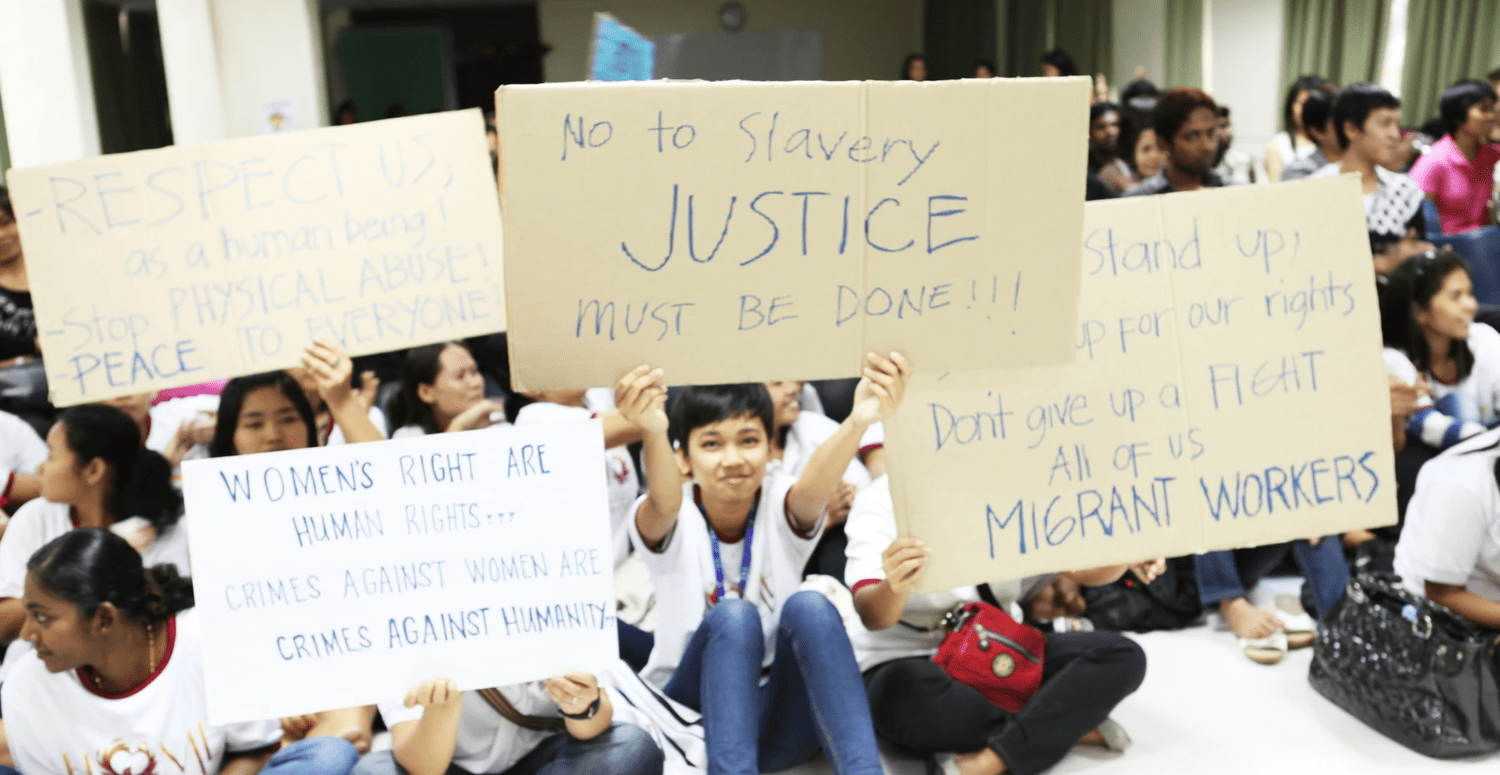
Migrant workers celebrating International Migrants’ Day 2014. (Source: HOME)
Understanding these social shackles offers an explanation into why Singapore justifies and enforces the current unequal system for MDWs—after all, if this is the “natural state”, what can be done about it ? An analysis into Singaporean law reveals how legislation continues to devalue migrant workers’ domestic labour: MDWs are blatantly excluded from the protections of the employment act and the work injury compensation acts (WICA) [12]. Linda*, 49, a domestic worker and community organiser, can attest to how these laws (or rather lack thereof) affect women. After working in Singapore for 3 years, she now resides in Hong Kong, and can compare and contrast the effects of labour laws on MDWs.
“In Hong Kong, we (MDWs) have a 24-hour rest day every week [13]. In Singapore, some go out (to rest) every Sunday, some every other week, some only once a month…our welfare depends on our employers.” Linda said, adding on that the mandatory monthly Singaporean rest day was also worse. MDWs usually work in the morning to prepare breakfast, and have to come back early in the evening to prepare for the day ahead - a fact seemingly acknowledged by the MOM’s guidelines, who note: “Employers and MDWs should openly discuss their respective needs and mutually agree on rest day arrangements”. These guidelines are a step back from the 24-hour rest day, and ignore the structural power imbalance between an employee and employer [14].
Still, it is worthwhile to remember that even this incomplete mandatory rest day represents a hard-won victory. It was created in 2023 not out of pity, but through mass struggle and blood. To this day, the murder of Ms Piang Ngaih Don remains fresh in the minds of many Singaporeans. Weighing just 24 kg at the time of her death, she had been brutally beaten and starved by her employers for years, until her body gave in [22]. It was only after mass public outcry and years of activism, that substantial changes were made: mandatory medical checks, and a non-compensatable monthly rest day [23].
Rest duration is not the only time where employers have the upper end. The very time that MDWs stay in Singapore is subject to their employers’ will. Much like male migrant workers, they can be sent back on short notice. The law requires that all outstanding salaries be paid before repatriation; in practice, much depends on the individual employer. “Employers can send helpers to (the) airport, even if the helper (is) not paid salary, how can they claim their salary when they are gone?” Linda states, noting the common fear that MDWs have of being repatriated, especially when they become sick and inconvenient to their employers [15].
“They chose to come here”
Figure 1
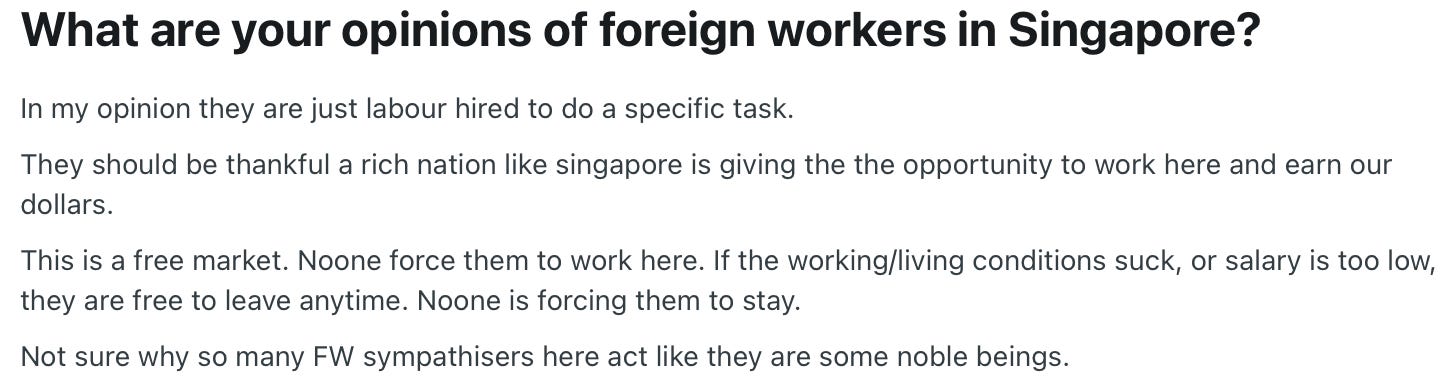
A post created by a Singaporean on the online forum Reddit
With all these exploitative practices, a common self-delusion to avoid this harsh reality is: “They chose to come here. If they don’t like it here, they can always go back.” Aside from the obvious abdication of social responsibility—plainly speaking, there is usually nowhere else to go. Many migrant workers pay thousands of dollars to even come to Singapore. This is often done under false promises, like a high-paying job that never materialises [16]. These workers frequently go into debt to even come here, only to have the rug pulled from under them. The possibility of going back, or going elsewhere, is less of a real alternative when they would have to go into even more debt to do so.
Even for workers who do not deal with agencies, their economic prospects at home further constrain their ability to pick and choose jobs. This is due to the historic and continuing systemic extraction and exploitation from imperialist countries, like the U$A [7]. As a result, the economy becomes dependent on technology and tools from the first-world: like GMO seeds, bought at monopoly prices. However, lacking the ability to develop such technologies, these nations can only trade non-monopoly goods, like GMO crops, sold at market prices [18].
This circle of dependency and extraction unleashes the full brutality of the free market onto these nations. Margins are low, businesses seek to cut labour costs by any means, making jobs unattractive, and even unsafe. “The Philippines is my home, but it is hard to find work. Even if you graduate from university, the basic salary is around 350 USD [17]. How to feed my family?” Linda exclaims.
This dominance of the monopoly capitalists, also known as imperialism, is a systemic problem. It cannot be overturned by well-meaning individuals, or even an entire nation alone. Yet, the possibilities for anti-imperialist actions are overflowing, even in a tightly-controlled nation like Singapore [21]. At a minimum, we need to demand that the migrant workers in our nation—and workers in general—are given enough time and wages to live. No one has to die of overwork ever again. To that end, Workers Make Possible has listed the following demands for Labour Day 2026. These demands are elaborated on in the labour day paper, at the bottom of the references section.
Join us at Hong Lim Park on the 1st of May, 3-7pm, to discuss action on the following:
WE DEMAND
Eight hours for work, eight hours for rest, and eight hours for living life
An 8 hour work day for all, a 5 day work week for all
At least 15 days of paid annual leave for all
Dependent care leave and other leave entitlements for all
A basic amount of sick leave without MC for all
Raise basic wages for all - so that we can reduce work hours
The right to disconnect, to not answer calls and texts after work hours
*Note: Persons in this article were given pseudonyms to protect their identity.
References
[1]Foreign workforce numbers - Singapore
[2]:Singapore’s migrant labour dilemma deepens as costs rise - The Business Times
[4]Wage growth, not one-off handouts, key to tackling cost pressures: PM Wong | The Straits Times
[5]MOM announcement of the minimum proportion of up-skilled workers in construction firms
[7]A world rate of profit: important new evidence – Michael Roberts
[9]Climate Endgame: Exploring catastrophic climate change scenarios | PNAS
[10]Migrant domestic worker eligibility - Singapore
[12]Decent Work Campaign 2022: Domestic Work and Singapore — HOME
[13]Rest Days, Holidays & Leaves - Overseas Employment Center Ltd.
[14]Preparing for your Migrant Domestic Worker’s Rest Days
[16]Why do migrant workers pay thousands of dollars to work in Singapore? - CNA
[17]New graduate salary in Philippines
[19]Kopi Sessions: The Foreign Worker Levy — Who Really Pays? — HOME
[20]Neither Family Nor Employee: The caregiver burden of migrant domestic workers in Singapore
[22]True Crimes of Asia: Myanmar maid’s death sparks reform in worker protection but gaps still exist
[23]#RestDayAllDay Campaign: Towards 24-Hour Rest Days for Singapore’s Migrant Domestic Workers — HOME